Air War South Atlantic (The Air Combat Trilogy Book 3) by Price Alfred & Ethell Jeffrey
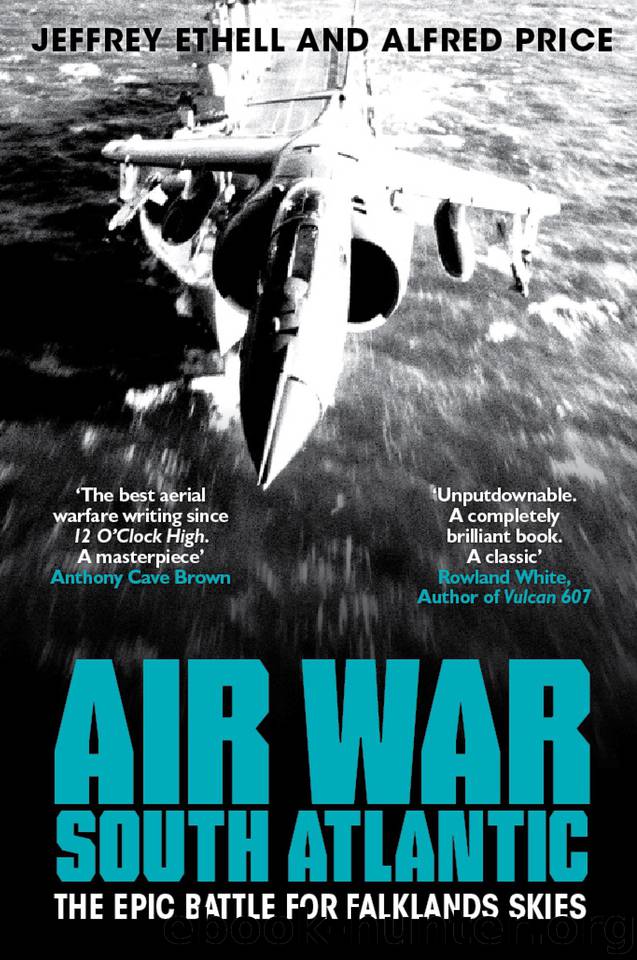
Author:Price, Alfred & Ethell, Jeffrey [Price, Alfred]
Language: eng
Format: epub
Publisher: Silvertail Books
Published: 2019-10-30T16:00:00+00:00
While all of this was happening, other attacking forces were approaching the target, also at low altitude. Piloting a Dagger of Grupo 6, Captain Horacio Gonzalez was one of a formation of four skirting around the south of West Falkland. ‘When we arrived at Isla Jorge [George Island] at the extreme south of Isla Soledad [East Falkland] we altered course towards the bay, then changed course again to go north towards San Carlos,’ he remembered. ‘Four minutes before reaching our target, with the Rivadavia Hills [Sussex Mountains] in sight, we accelerated to 550 knots [630 m.p.h.]. We hopped over the Rivadavia ridge, which is about 300 metres [1,000 feet] high, and entered San Carlos Bay, where we could see between ten and thirteen ships. As soon as we passed over the Rivadavia Hills the first missiles were fired at us from on land, then the warships in the north joined in and everyone began firing at us with anti-aircraft weapons of all sizes. The four of us flew in a fluid formation, practically line abreast with about 300–500 metres [330–550 yards] between aircraft; between the leader and the No. 4 there was an angle of 10–20 degrees, so that the Daggers could converge on a ship and all attack before the first bomb exploded,’ Gonzalez continued. ‘Between the Rivadavia Hills and the ships was only about a mile; they were very close to the southern end of San Carlos Bay. We had to begin our attack immediately, there simply was no time to discuss which target we would go for. The flight of four attacked one ship which was larger than the rest, dropped our bombs, and began our escape, skimming the water, passing between the ships. Since there were so many ships packed together so closely, we could see the British had considerable difficulty firing at our aircraft because their guns and missiles could have hit their own ships. ’
Once the Daggers were clear of San Carlos Water they swung round on to a westerly heading, but still they faced dangers. ‘As we entered the Strait of San Carlos [Falkland Sound] we were jumped by a Sea Harrier which sprayed cannon fire at the No. 3 and No. 4, but without hitting them,’ recalled Gonzalez. ‘We fled from the Sea Harrier and continued at low altitude for about 40 miles, then began climbing to return to base.’ Later examination of the Daggers on the ground would reveal that three of the four had taken hits from small-arms fire.
It is difficult to link Gonzalez’s account with British reports of the attacks on shipping in San Carlos Water that day, but this is to be expected. As they swept through the waterway the attacking formations were within view of those on the ships for less than half a minute, during which all hell was let loose; and, as Gonzalez suggested, there was considerable risk of those on the ships or ashore being hit by rounds intended for aircraft coming past. The same incident looked quite different when seen from opposing sides.
Download
This site does not store any files on its server. We only index and link to content provided by other sites. Please contact the content providers to delete copyright contents if any and email us, we'll remove relevant links or contents immediately.
| Africa | Americas |
| Arctic & Antarctica | Asia |
| Australia & Oceania | Europe |
| Middle East | Russia |
| United States | World |
| Ancient Civilizations | Military |
| Historical Study & Educational Resources |
Cecilia; Or, Memoirs of an Heiress — Volume 1 by Fanny Burney(32527)
Cecilia; Or, Memoirs of an Heiress — Volume 2 by Fanny Burney(31928)
Cecilia; Or, Memoirs of an Heiress — Volume 3 by Fanny Burney(31916)
The Secret History by Donna Tartt(19002)
Sapiens: A Brief History of Humankind by Yuval Noah Harari(14346)
Leonardo da Vinci by Walter Isaacson(13292)
The Radium Girls by Kate Moore(12003)
Sapiens by Yuval Noah Harari(5346)
How Democracies Die by Steven Levitsky & Daniel Ziblatt(5200)
The Wind in My Hair by Masih Alinejad(5070)
Homo Deus: A Brief History of Tomorrow by Yuval Noah Harari(4890)
Endurance: Shackleton's Incredible Voyage by Alfred Lansing(4743)
Man's Search for Meaning by Viktor Frankl(4556)
The Silk Roads by Peter Frankopan(4512)
Millionaire: The Philanderer, Gambler, and Duelist Who Invented Modern Finance by Janet Gleeson(4448)
The Rape of Nanking by Iris Chang(4189)
Joan of Arc by Mary Gordon(4080)
The Motorcycle Diaries by Ernesto Che Guevara(4069)
Stalin by Stephen Kotkin(3940)
